A development-led partner puts a perfumer and a sampling budget in front of you; a production-led partner puts a line, a calendar and a price list in front of you. A niche house eventually needs both kinds of capability, but not necessarily from the same supplier at the same stage. The trade-off is less about quality than about control against speed, and it should be decided against your own development capacity rather than by whatever the first proposal happens to offer.
Key takeaways
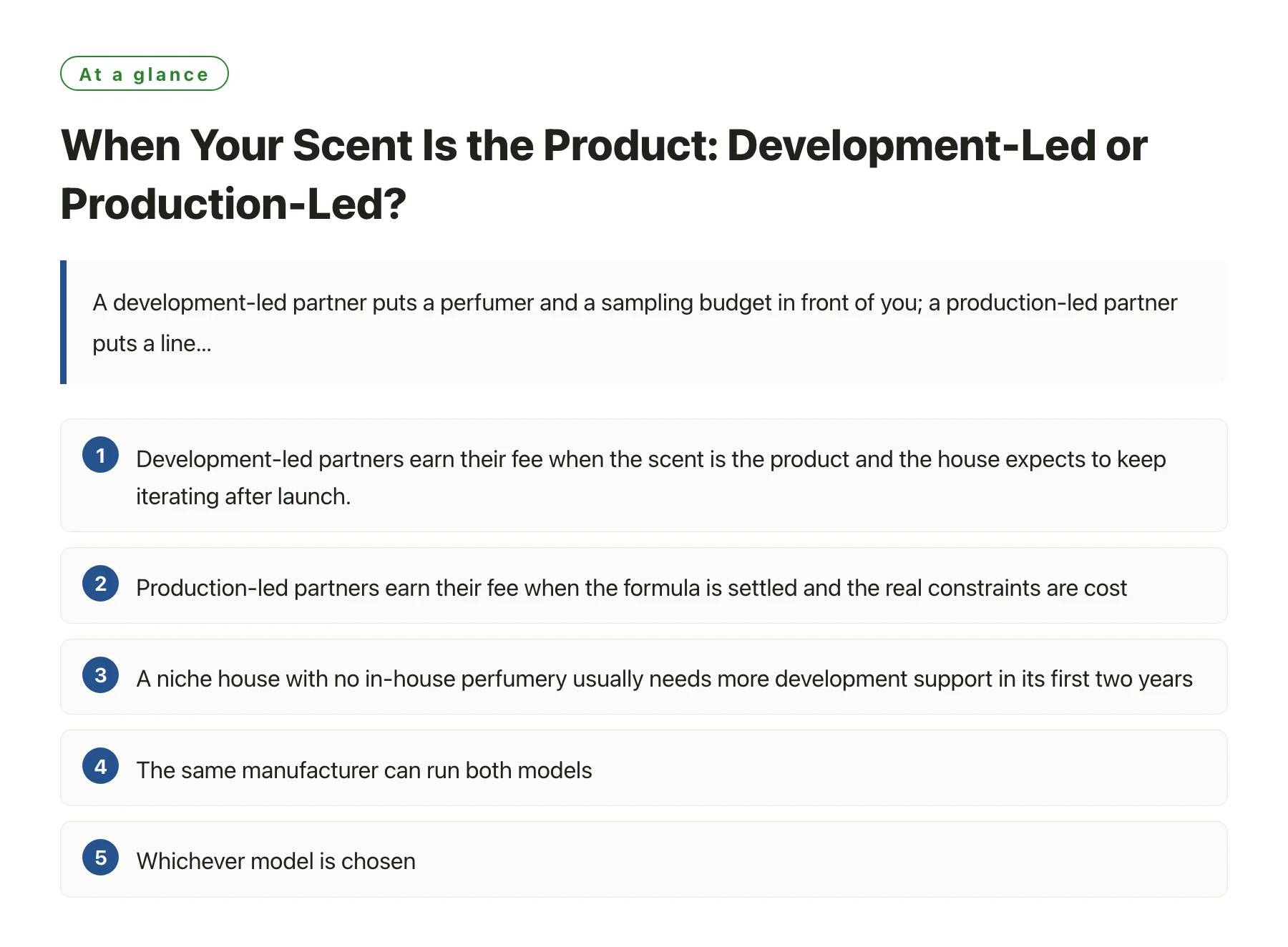
- Development-led partners earn their fee when the scent is the product and the house expects to keep iterating after launch.
- Production-led partners earn their fee when the formula is settled and the real constraints are cost, yield and delivery reliability.
- A niche house with no in-house perfumery usually needs more development support in its first two years, not less.
- The same manufacturer can run both models, so the useful question is which model this particular project is in.
- Whichever model is chosen, formula ownership, sampling terms and change control have to be settled in writing before work begins.
Most partner comparisons for a niche house are run as a beauty contest between factories. That framing produces a shortlist of similar-sounding names and very little else, because nobody asks the question that actually separates them: how much of the development are you taking on, and what does that cost me in control?
This piece splits that question into the two models a small house really encounters, and sets out where each one earns its keep and where it starts to cost more than it is worth.
What each model is actually selling
A development-led partner sells iterations. It expects to brief a perfumer, run several rounds of samples, and take a position on how the scent should be built. Its cost structure includes creative time, trial quantities of materials and laboratory hours, and its calendar includes rounds that may not lead anywhere.
A production-led partner sells repetition. It expects a defined formula, a fixed specification and a quantity, and it competes on yield, filling accuracy, packaging handling and the reliability of the delivery date. Creative time is not the product; predictability is.
Both descriptions are honest, and neither is a criticism. Trouble begins when a house buys one model and expects the behaviour of the other, whether that means asking a production-led partner to invent a signature accord, or paying a development-led partner to manufacture a fragrance that was finalised months ago.
It is worth remembering that perfumery is a technical discipline before it is a creative one. The chemistry that makes a formula stable, soluble and well-behaved at the target dosage is a separate skill from composing an accord, and a manufacturer that only does the second is not really a fragrance partner [1].
That distinction is the practical test. A scent development and manufacturing partner will talk about odour profiles, dosage and stability in the same conversation, because in that model the scent and the product cannot be separated.
The trade-offs, side by side
| Dimension | Development-led partner | Production-led partner |
|---|---|---|
| What you are buying | Iterations, direction-setting and perfumer time | Repeatable output against a defined specification |
| Where the money sits | Sampling rounds, trial materials and lab hours | Materials, filling, packaging and freight |
| Speed to first sample | Slower, because the scent is still being built | Faster if a library match is acceptable |
| Speed to scale | Depends on how quickly the formula can be locked | Fast, because scale is the core competency |
| Where it fits best | A house whose differentiation is the scent itself | A house whose differentiation is price, format or channel |
| The main risk | Paying for sample rounds that never land | A formula that is safe and cheap but not distinctive |
If two rows pull in opposite directions, that is normal. Most niche projects sit in the middle, and saying so out loud produces a better proposal than pretending to be at one extreme.
Choosing against your own capacity, not the proposal
If you have no perfumer on staff
Development support is not a luxury in that situation; it is the difference between a coherent range and a folder of unrelated samples. The question to settle is who makes the creative decisions — you, the partner's perfumer, or a brief that both sides interpret differently.
An honest version of that conversation usually ends in one of two answers: the partner proposes directions and you choose, or the partner proposes and you refine. Write down which one it is, because it decides who owns the next round of work when the first samples miss.
If the formula is already settled
Then the value of a development-led relationship drops sharply, and a production-led partner is likely to be faster and cheaper for the same output. A house that has already locked its scent is buying manufacturing, packaging and logistics, and paying for creative time on top of that is simply waste.
This is where a factory that offers private label fragrance production tends to fit better than a studio. The scope is defined, the price is quoted per unit, and the performance question is about consistency rather than invention.
If you are between the two
Most small houses are. The workable pattern is to buy development support for the hero scent and production capacity for everything around it, then revisit the split once the range has proven itself. That keeps the creative spend concentrated where it changes the customer's experience.
A manufacturer that runs their OEM/ODM manufacturing services can often serve both needs under one contract, which removes the friction of moving files, specifications and retained samples between suppliers. The trade-off is that you then depend on one partner's calendar for both stages.
What to fix in writing before the work starts
Ownership of a formula is an intellectual property question before it is a commercial one. Copyright, trade secrecy and design protection each cover different things, and none of them covers a scent in the way a layperson expects, so the contract has to say plainly who may use the formula, where and for how long [2].
Beyond ownership, three terms do most of the work. Sampling terms decide how many rounds are included and what extra rounds cost. Change control decides what happens when the brand or the market forces a formula adjustment. Reference retention decides what physical evidence exists if the two sides disagree later.
There is also a scoping question that experienced buyers ask early: what does the partner expect you to bring, and what does it expect to own? A short written answer to that, before the first brief, prevents the most common form of expensive misunderstanding in niche fragrance work.
If the choice is still genuinely open, it is worth seeing how other small brands have resolved it in practice. what niche fragrance brands need from a factory is a different question from what a large retailer needs, and the answers do not usually overlap.
Ask one question before you sign: if the sampling rounds end without a formula you want to produce, what do you owe and what do you own? The answer tells you which model you have actually bought, whatever the proposal called it.
Sources
- Chemistry World (Royal Society of Chemistry) —— The Royal Society of Chemistry's magazine, covering chemistry research and explanations of everyday materials including aroma compounds.
- WIPO — World Intellectual Property Organization —— The UN agency for intellectual property; resources on industrial design and patent protection relevant to product and packaging design.
Frequently asked questions
Can one manufacturer be both development-led and production-led?
Yes, and many are. What matters is that the project is explicitly assigned to one mode, because the pricing, the calendar and the responsibilities differ between them.
Is a development-led partner always more expensive?
Per sample round, usually. Across a whole launch it depends on how many rounds you need. A house that would have run six rounds alone may need fewer with experienced guidance.
When should a niche house switch from development-led to production-led?
Once the hero formula is locked and the range is stable. Continuing to pay for creative time after that point rarely changes the product.
How many sample rounds should be included in the fee?
Two or three is a common starting point. Ask what an extra round costs and how long it takes, because that is the number you will actually manage against.
Does the choice affect who owns the formula?
It can, which is why ownership should be agreed independently of the commercial model. Decide the ownership terms first, then choose the partner that fits them.