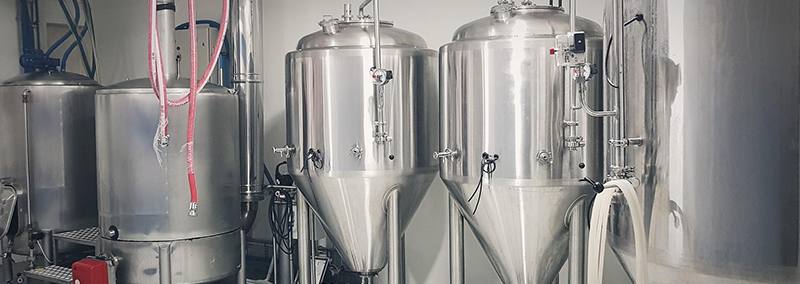
The best craft beer equipment size depends on annual sales, brew frequency, fermentation time, and how much beer can be packaged each week. A 5 BBL brewhouse running four single-batch days produces about 1,040 BBL of wort across 52 weeks before losses, while a 10 BBL system running two batches on four days reaches 4,160 BBL theoretically. Finished volume may be 5–15% lower after trub, yeast, hops, transfers, and packaging. Small taprooms often fit 3–7 BBL systems; growing breweries commonly use 10–20 BBL equipment. Size the brewhouse around realistic weekly sales, then provide enough fermentation capacity to keep it running without waiting for an empty tank.
In U.S. brewery planning, 1 BBL equals 31 U.S. gallons, so a 5 BBL batch is 155 gallons and a 10 BBL batch is 310 gallons. The Alcohol and Tobacco Tax and Trade Bureau uses the same 31-gallon barrel for beer reporting. Nominal batch size is only the first number to calculate because not every gallon entering fermentation becomes saleable beer.
A brewery transferring 10 BBL into a fermenter may package only 8.5–9.5 BBL, depending on beer style and process. A lightly hopped lager can retain more liquid than a heavily dry-hopped IPA because hop material, yeast sediment, sampling, tank bottoms, transfer lines, and packaging all remove volume. Planning around 90% finished yield gives 900 saleable BBL from 1,000 BBL entering the cellar rather than assuming the full 1,000 BBL reaches kegs or cans.
That production loss makes annual sales a better starting point than vessel diameter. If expected sales are 1,500 BBL and packaged yield is 90%, the brewery must produce roughly 1,667 BBL before final losses. At 48 operating weeks per year, the required average is about 34.7 BBL per week, so a 5 BBL brewhouse would require almost seven batches weekly while a 10 BBL brewhouse would require about 3.5.
| Brewhouse size | Nominal volume per batch | 4 batches/week for 48 weeks | 8 batches/week for 48 weeks |
|---|---|---|---|
| 3 BBL | 93 gal | 576 BBL/year | 1,152 BBL/year |
| 5 BBL | 155 gal | 960 BBL/year | 1,920 BBL/year |
| 10 BBL | 310 gal | 1,920 BBL/year | 3,840 BBL/year |
| 15 BBL | 465 gal | 2,880 BBL/year | 5,760 BBL/year |
| 20 BBL | 620 gal | 3,840 BBL/year | 7,680 BBL/year |
Those figures are theoretical wort volumes, not guaranteed sales volumes. A 10 BBL brewery scheduled for 3,840 BBL could finish near 3,456 BBL at 90% yield, and fewer barrels if maintenance, holidays, slow fermentation, packaging delays, or recipe changes reduce the planned 48-week schedule.
Production frequency then determines whether a smaller brewhouse remains practical. A 5 BBL system producing 30 BBL per week requires six batches; if each complete cycle takes six hours, brewing alone can consume 36 equipment-hours before cleaning, preparation, grain handling, cellar work, and packaging are counted. A 10 BBL system reaches the same 30 BBL with three batches, which changes staffing requirements even though annual sales remain identical.
A brewhouse that looks inexpensive on the equipment quote can become expensive when staff must run twice as many brew cycles for several years.
The cellar usually sets the next production limit because fermentation occupies equipment far longer than wort production. A brew may leave the brewhouse within one working day, while beer can remain in a fermenter for 10, 14, 21, or more than 30 days. If a 10 BBL brewhouse produces 50 BBL each week and average tank occupancy is 14 days, about 100 BBL is already sitting in fermentation before allowing any scheduling margin.
Running every fermenter at 100% planned occupancy leaves little room for beer that needs an extra three days, a delayed canning run, or an unscheduled yeast issue. A brewery producing 50 BBL weekly may therefore install more than the mathematical minimum of 100 BBL of fermentation space. Adding 20–30% cellar headroom can reduce situations where brewing stops because no vessel is available.
Fermenters also do not need to match the brewhouse one-for-one. A 10 BBL brewhouse can feed 10 BBL fermenters for seasonal products and 20 BBL fermenters through two consecutive batches for higher-volume beers. A brewery selling 20 BBL of pale ale every cycle but only 10 BBL of a rotating stout can use mixed tank sizes without forcing every recipe into the same production volume.
This approach becomes more useful as the number of regular products grows. If one IPA accounts for 40% of brewery volume, a lager 25%, and several rotating beers share the remaining 35%, equal-sized fermenters may not reflect actual sales. Larger tanks can serve frequent beers, while smaller vessels keep slower products from occupying more stainless capacity than their sales require.
Beer style also changes the tank count. An ale occupying a fermenter for 14 days can complete about 26 theoretical cycles in 52 weeks, while a lager occupying the same vessel for 28 days completes roughly 13. Actual numbers are lower after cleaning, transfers, quality checks, and schedule gaps, so two breweries producing the same annual barrel volume may need very different cellar sizes.
For a taproom operation, smaller batches can still be commercially sensible because variety may matter more than maximum barrels per labor hour. The Brewers Association classifies a brewpub as a restaurant-brewery selling at least 25% of its beer on site, while its microbrewery definition covers breweries producing under 15,000 BBL annually and selling 75% or more off site. Sales route therefore affects how aggressively equipment needs to scale.
A 3–5 BBL system can suit a brewery selling mostly pints from eight or twelve taps because 3 BBL equals roughly 744 U.S. pints before losses, while 5 BBL equals about 1,240. At 90% usable yield, those figures fall to roughly 670 and 1,116 pints. Producing smaller batches lets the tap list change more often without holding several weeks of slow-moving beer.
Distribution changes the calculation because a single wholesale release can consume much more volume. Twenty U.S. half-barrel kegs equal 10 BBL, so a brewery shipping 60 half-barrel equivalents in one cycle needs around 30 BBL before considering its own taproom demand. A 5 BBL system would need six full batches for that shipment alone; a 15 BBL system needs two.
Packaging capacity must therefore be considered beside the brewhouse. If a brewery produces 40 BBL every week but can package only 25 BBL, approximately 15 BBL remains in tanks or storage each week until the packaging schedule catches up. After four weeks, the gap can reach 60 BBL, occupying vessels that would otherwise receive new beer.
A canning line rated at a certain cans-per-minute speed should not be treated as its full daily output. Setup, dissolved oxygen checks, seam inspection, label changes, rinse cycles, product changeovers, breaks, and cleanup reduce operating time. Even an 80% effective production window turns an eight-hour shift into only 6.4 hours of actual filling, so packaging specifications should be compared with realistic weekly volume.
Utilities have to rise with batch size as well. A 20 BBL brewhouse handles four times the nominal liquid volume of a 5 BBL brewhouse, affecting hot-water storage, heating, chilling, pump flow, cleaning water, wastewater, and electrical demand. Larger fermenters also add glycol demand, especially when several tanks are cooling from fermentation temperature at the same time.
Space planning should use actual vessel drawings rather than tank volume alone. A 20 BBL fermenter may fit the floor area but fail because ceiling clearance is insufficient for installation, top fittings, or service. Operators also need access to manways, valves, sample ports, CIP connections, drains, glycol piping, and nearby walkways; losing even 15% of usable production-floor area to poor access can change how many tanks the building can support.
Suppliers such as hem brewing can provide brewhouse, fermentation, conditioning, and utility configurations across different production scales, but equipment selection should begin with a brewery's own weekly volume model. Supplier tank drawings and utility specifications can then be checked against ceiling height, drainage, electrical service, heating method, refrigeration capacity, and future tank positions before fabrication begins.
Future sales should be tested with several production levels rather than a single forecast. A brewery expecting 800 BBL in year one, 1,200 BBL in year two, and 1,800 BBL in year three may find that a 5 BBL brewhouse reaches an uncomfortable number of weekly batches before the third year. A 10 BBL system with space for additional 20 BBL fermenters may allow production growth without replacing the brewhouse.
That planning matters in a mature U.S. beer market. Brewers Association data show craft brewers produced about 22.0 million BBL in 2025, down 4% from 2024; 60% of reporting breweries recorded lower production, 39% grew, and 1% remained flat. Buying equipment for an assumed high-growth market can therefore leave expensive capacity unused.
The brewery count also supports conservative capacity planning. The Brewers Association reported 9,578 U.S. craft breweries in 2025, down 2.9% from 2024, including 3,784 taprooms, 3,525 brewpubs, and 1,994 microbreweries. A new brewery does not need to imitate the equipment scale of a regional producer when most of its expected revenue will come from a local taproom.
A practical equipment plan can be checked with a small set of operating numbers:
-
Planned finished beer sales: 2,000 BBL/year
-
Expected packaged yield: 90%
-
Required pre-loss production: about 2,222 BBL/year
-
Operating calendar: 48 weeks
-
Required production: about 46.3 BBL/week
-
10 BBL brewhouse: about 4.6 batches/week
-
5 BBL brewhouse: about 9.3 batches/week
-
Average fermenter occupancy: 14 days
-
Minimum beer in fermentation at steady output: about 92.6 BBL
At that scale, five 20 BBL fermenters provide 100 BBL of nominal cellar volume, but the margin is only about 8%. Adding a sixth 20 BBL vessel raises nominal fermentation capacity to 120 BBL and gives roughly 30% more space than the average two-week requirement. That extra vessel can accommodate longer conditioning, scheduling changes, or a temporary packaging delay without immediately stopping wort production.
A 7–10 BBL brewhouse often fits breweries expecting a few thousand barrels per year because one or two daily batches can cover moderate growth without requiring constant brewing. A 15–20 BBL system fits better when several products repeatedly move through distribution, while 30 BBL and larger systems require corresponding fermentation, brite tank, cold storage, packaging, utility, and warehouse capacity.
The final equipment size should be tested against the busiest realistic week rather than the average month. If annual demand is 2,000 BBL but summer sales are 40% above the weekly average, equipment sized with no spare cellar or packaging capacity may fall behind during the period when inventory is needed most. Designing around peak weekly sales, real tank occupancy, 5–15% liquid loss, available labor, and room for added fermenters produces a brewery that can meet sales without relying on excessive brew days.