A trade dataset is useful only when its definitions, coverage, and detail fit the research question. Before relying on a result, ask who reported it, what product it covers, how periods and values are measured, what may be missing, and which business conclusion the record can actually support.
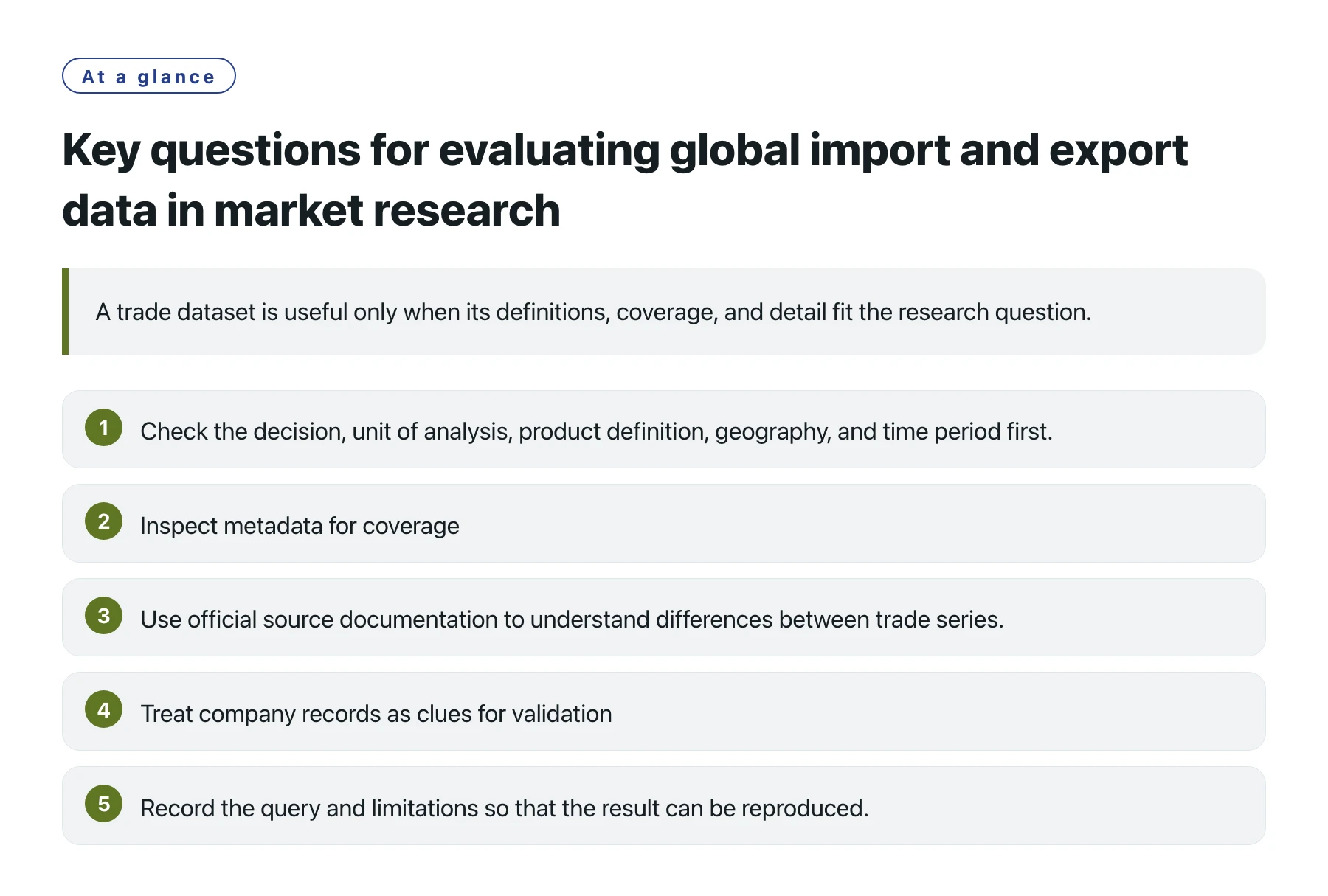
Key takeawaysCheck the decision, unit of analysis, product definition, geography, and time period first. · Inspect metadata for coverage, valuation, classification changes, revisions, and missing values. · Use official source documentation to understand differences between trade series. [1] · Treat company records as clues for validation, not as proof of identity or purchasing intent. · Record the query and limitations so that the result can be reproduced.
When market research teams evaluate a database, they often begin with its size or feature list. A more useful evaluation starts with the assignment the data must support. Can it answer the product, geography, and time question at the required level? Can the analyst interpret the fields? Can a colleague review and reproduce the result?
The questions below are designed for a data trial, a public-statistics extraction, or a review of an existing analysis. They help separate data availability from data fitness: a field may exist without being reliable enough for the conclusion someone wants to make.
1. Ask whether the scope matches the decision
| Question | What to verify | Warning sign |
|---|---|---|
| What decision will this answer? | Name the user, action, and next step. | The analysis begins with a broad search and has no decision owner. |
| What is the unit? | Country, product code, company, shipment, or route. | The report switches between aggregate totals and individual records without explanation. |
| Which product is in scope? | Commercial terms, code, description, revision, and exclusions. | A broad code is treated as the exact catalogue product. |
| Which geography and period? | Reporter, partner, flow direction, dates, and retrieval vintage. | Countries or years are compared with inconsistent boundaries. |
If the scope cannot be written clearly, refine the question before judging whether a dataset is good.
2. Ask how the figures were compiled
Check whether the records describe imports, exports, re-exports, or another measure. Identify the reporting authority and statistical system. Ask whether free zones, customs warehouses, processing trade, and other special movements are included. These details can affect totals and determine whether a trend is comparable over time.
International trade data are not all generated under identical conventions. The WTO’s technical notes explain, among other matters, that general and special trade systems handle some warehouse and re-export flows differently. This is why analysts should read the source definitions before matching one country’s series with another’s. [1]
If the research uses a company or shipment dataset, ask how source records are collected, normalized, and updated. Find out whether names are transliterated, whether duplicate entity records are merged, and what the product description represents. A clear answer should be tied to documentation or sample records rather than to a general marketing statement.
3. Ask whether the product classification holds up
Product codes are designed for statistical or customs classification, not for every commercial taxonomy. A code can include variants that a product manager would treat as separate products, while a commercial name can span multiple codes. Request the official description, the level of detail, and the applicable revision.
For U.S. imports, the USITC’s Harmonized Tariff Schedule provides the current national tariff classification and related statistical categories. It is based on the international Harmonized System but includes U.S.-specific detail. Researchers should use the relevant notes and edition for the period and not assume that every national extension has a direct counterpart elsewhere. [2]
Test borderline cases. If a category’s meaning is ambiguous, inspect neighboring codes and explain whether they were included. If two reasonable mappings lead to different market conclusions, disclose both and identify which mapping best fits the actual product.
4. Ask what a value can and cannot tell you
Confirm the unit, currency, valuation basis, and date field before comparing amounts. Values can change because of price, exchange rate, volume, or product composition. If quantity is provided, check whether it uses a consistent unit. A precise decimal does not make a measure precise if its definitions are unclear.
Look at multiple periods and identify missing or revised data. A blank, suppressed figure, or unreported month should not be treated as a zero. A sudden jump may coincide with a new reporting practice, a classification update, or an unusual shipment rather than a sustained change in commercial demand.
The Census Bureau’s international trade resources demonstrate how official data can be viewed by classification, geography, time series, and product. The chosen table determines what the result represents, so preserve the source page, selected resource, and retrieval date with the analysis. [3]
5. Ask whether the result can be reproduced
Save the query, filters, data export, source documentation, and any code mapping. Note each transformation: unit conversion, aggregation, name normalization, duplicate handling, or exclusion. Ask a colleague to recreate a small sample using the saved information. If they cannot, the workflow needs more detail.
Reproducibility is especially important when analysts revise product terms or add countries after seeing the first result. Keep the initial scope and explain each later change. This makes it possible to distinguish a deliberate research improvement from a filter change that happens to support a preferred market.
6. Ask whether detail is relevant and permitted
More granular data is not automatically more valuable. Company and shipment details may help identify organizations or routes for follow-up, but the fields may be incomplete, delayed, ambiguous, or restricted by the source’s terms. Understand what use is permitted and whether sensitive personal or business information is included.
If the research requires searchable company trade data, evaluate sample company records against the exact task. Check whether entity identities can be resolved, whether product descriptions are specific enough, and whether the covered geography and period meet the brief. Then validate any promising organization through independent company information before treating it as a real prospect.
For each field, ask what action it supports. If no one can explain how a data point changes the next research step, it may add complexity without adding decision value.
7. Ask whether the conclusion is appropriately limited
A good evaluation states the strongest supported conclusion and the boundary beyond which the data should not be used. Aggregate trade figures may support a market screen; they do not establish unmet demand, a company’s current procurement plan, or the likelihood of winning business. Shipment records can suggest activity; they do not guarantee that a named entity is a suitable customer.
Use a limitations note to disclose missing periods, code ambiguity, non-comparable definitions, revisions, and uncertain matches. If the data cannot resolve an important issue, identify the next evidence source: customer interviews, regulations, price checks, direct verification, or a different official series.
The purpose of evaluation is not to find a perfect dataset. It is to determine whether a specific dataset is adequate for a defined task and to keep the recommendation within that evidence boundary.
Sources
Frequently asked questions
What is the most important question when evaluating trade data?
Whether the source’s definitions, coverage, product detail, and time period fit the actual business decision.
Can researchers combine different countries’ trade figures directly?
Only after checking their reporting systems, valuation, coverage, units, product classifications, and revisions for comparability.
Is a company record enough to qualify a buyer?
No. Confirm the entity, current activity, product fit, and permitted use with independent evidence.
What should be saved to make a result reproducible?
The source, retrieval date, query, filters, code mappings, raw export, transformations, and interpretation notes.